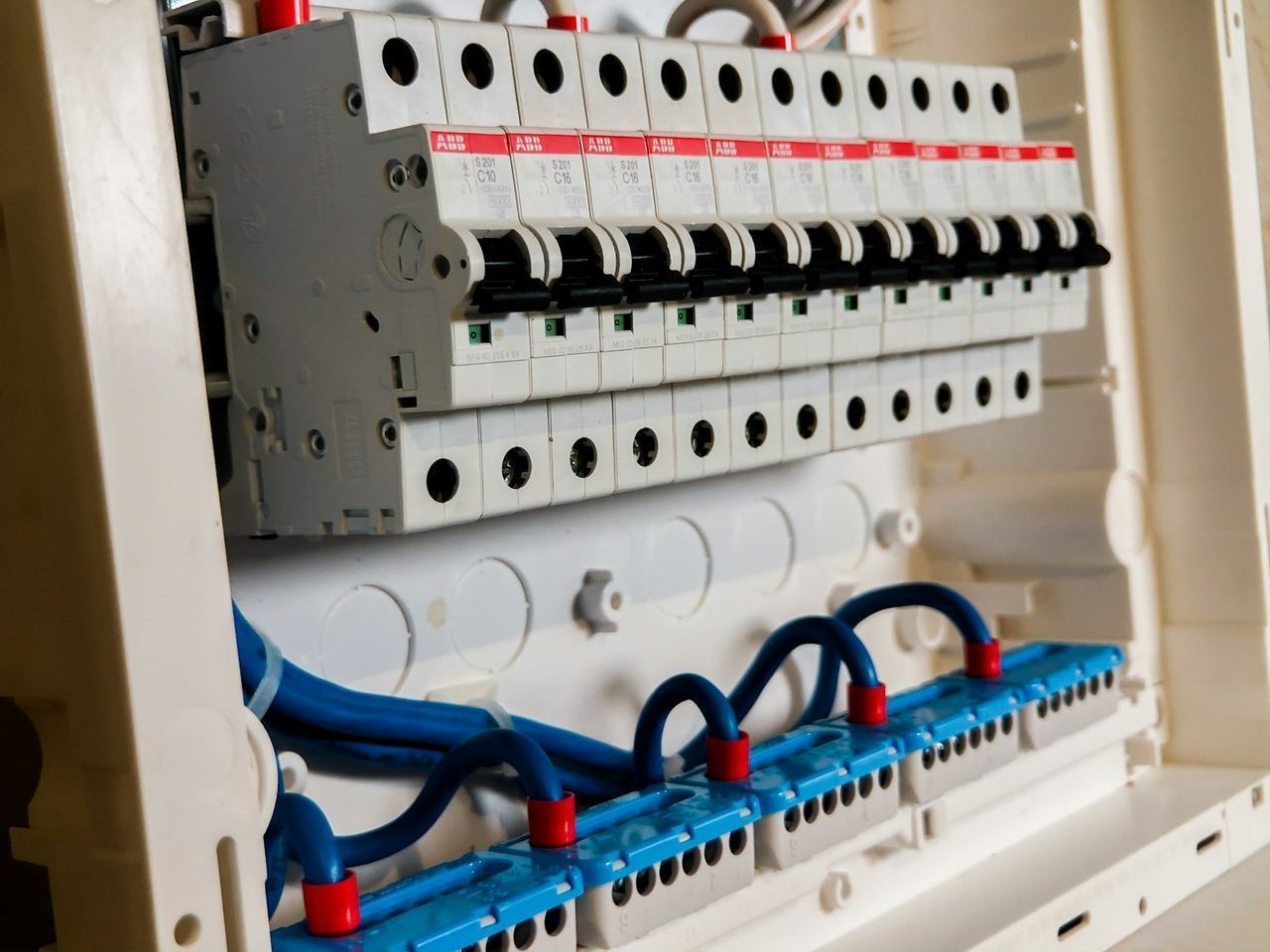
A breaker that keeps tripping is doing its job — cutting power because the circuit hit its safe limit. In almost every Stockton home, the cause is one of four things: an overloaded circuit (most common), a short circuit, a ground fault, or a worn-out breaker itself. Which one you have determines whether you can fix it yourself or need to call a licensed electrician. Here's how to tell them apart in about five minutes.
A circuit breaker has one job: cut power to a circuit before that circuit damages itself or starts a fire. It's a safety device, not a switch. When it trips, the breaker is doing what it was designed to do — interrupting a current that exceeds what the wiring on that circuit can safely carry.
So a tripping breaker isn't usually "broken." It's responding to one of four real conditions: an overloaded circuit, a short circuit, a ground fault, or a breaker that's worn out and tripping below its rating. The breaker can't tell you which one. That's what we're going to.
1. Overload (most common by far). Every circuit has a current limit — usually 15 amps in a bedroom or living room, 20 amps in most kitchen and bathroom circuits. Plug in more wattage than the circuit can handle and the breaker trips. The trip usually happens when you turn on one specific high-draw appliance — the microwave, a toaster oven, a space heater, a hair dryer, a vacuum.
The breaker is doing exactly what it should. The fix isn't a bigger breaker (that would let the wiring overheat — like removing your smoke detector instead of replacing the battery). The fix is to either spread the loads onto different circuits or add a dedicated circuit for the appliance that's pushing the limit.
2. Short circuit. A short circuit happens when a hot wire touches a neutral wire directly — bypassing the load and pulling huge current instantaneously. The breaker should trip the moment power is restored. You'll often hear a snap, smell ozone or something burnt, and see a slight scorch mark. Short circuits come from damaged cords, broken light fixtures, animal-chewed wiring, a nail or screw driven into a wire behind drywall, or moisture in a junction box. They're not subtle: if a breaker won't stay reset even with nothing plugged into the circuit, you almost certainly have a short.
3. Ground fault. Similar to a short circuit, but the hot wire touches a grounded surface (a metal box, a ground wire, water) instead of the neutral. This is what GFCI outlets and breakers are designed to detect — they cut power within milliseconds. If a GFCI breaker keeps tripping and you've already ruled out moisture (outdoor outlets after rain, bathroom outlets near a wet sink), the issue is usually a faulty appliance or a degraded wire connection on that circuit.
4. Failing or worn-out breaker. Breakers wear out. Inside is a small spring-loaded mechanism that heats and cools every time current passes through it; over years, the calibration drifts. A breaker that used to trip at 20 amps might now trip at 15 — well below the wiring's actual safe capacity. This is uncommon in modern panels but common in older Federal Pacific, Zinsco, and Pushmatic panels, which matters if you're in a 1950s–80s Stockton home where those brands are still in service.
Run through this short diagnostic:
Sometimes the wiring is fine and a single appliance is the culprit. Common offenders we see in Central Valley homes:
A quick test: plug the appliance into a different circuit. If it trips that one too, the appliance is the problem. If it doesn't, the original circuit is being asked to do too much.
A lot of older Stockton neighborhoods — Brookside, Lincoln Village, Country Club, parts of Magnolia, the streets around Lakeshore — still have their original 1960s or 70s electrical panels. If yours is a Federal Pacific (FPE), Zinsco, or Pushmatic, you're in a category of panels with documented breaker-failure issues. Those panels are also the ones most insurance carriers in this area are now flagging at renewal.
If your home has one of those panels and you're seeing tripping that doesn't track to any obvious cause, the panel itself can be part of the story — either breakers tripping below their rating, or, worse, breakers failing to trip when they should. Our panel upgrades page covers what an upgrade involves and why insurance carriers are pushing them.
Newer panels (post-1990s, modern Square D, Eaton, Siemens) very rarely have this problem. If you're in a Tracy new build or a recent Stockton subdivision, the issue is much more likely to be on the circuit side than the panel side.
Before calling anyone, these are reasonable homeowner-level checks:
The line is roughly: if you can see what's wrong and unplug it, you can probably resolve it yourself. If you can't see the cause, or the panel is warm, or the breaker won't reset at all, or you suspect a short — that's a call.
A licensed electrician will measure actual current on the circuit, check for loose connections in junction boxes, test the breaker itself to confirm it's tripping at the right amperage, look for hidden wire damage (animal chew, drywall screws), tell you straight whether it's a circuit issue or a panel issue, and quote the actual fix with a permit if one's needed.
A licensed electrician we connect you with handles all of that. In Stockton we usually match calls within an hour or two during business hours.
Describe your electrical job and where you're located. We'll match you with the right person and get back to you fast — usually same day.
No obligation. Takes 30 seconds.