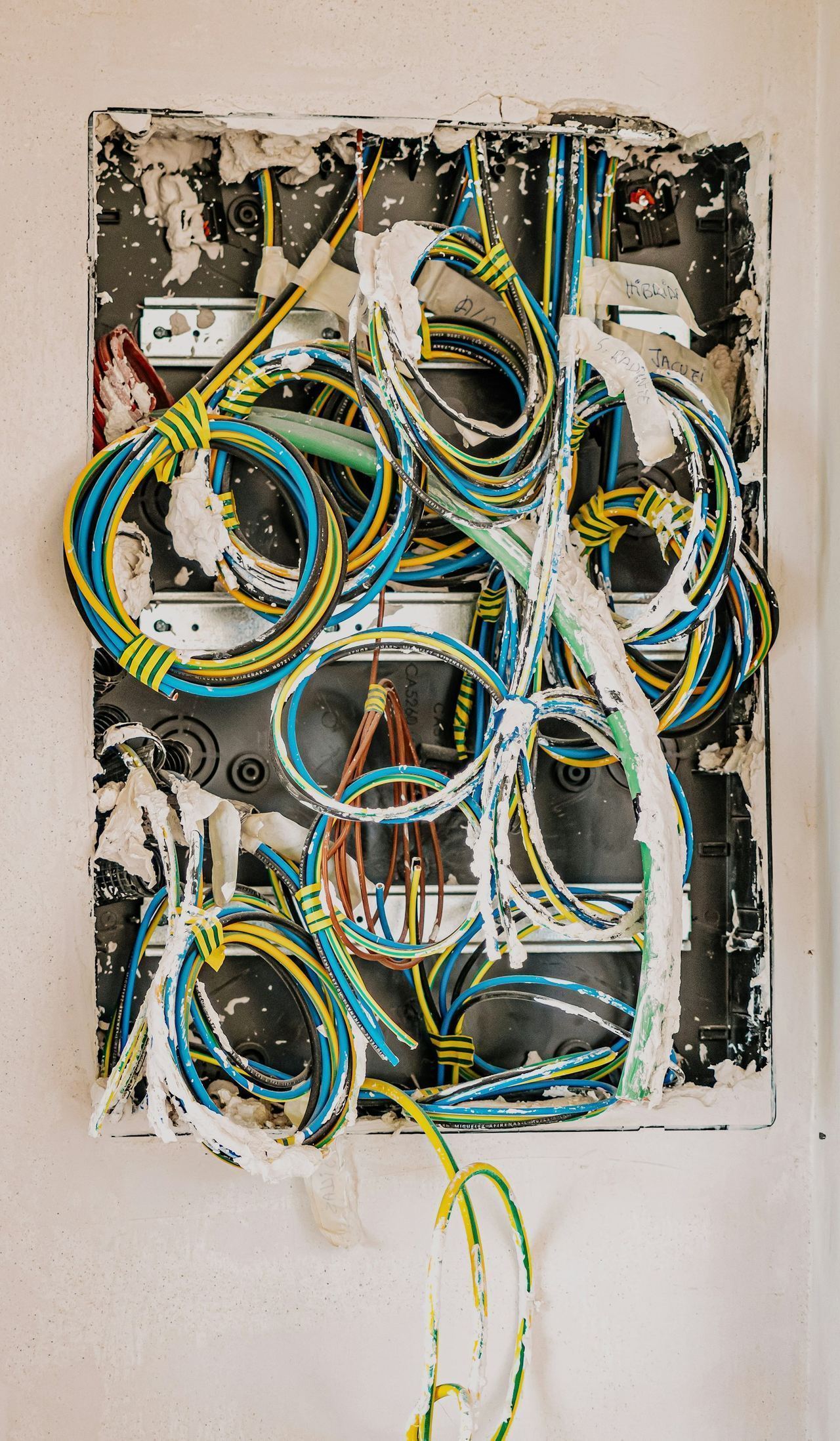
The eight most common causes of home electrical fires, in order of frequency, are: outdated wiring (aluminum, knob-and-tube, or ungrounded two-prong), overloaded circuits, damaged extension cords and power strips, worn or loose outlets and switches, Federal Pacific and Zinsco panels, unpermitted DIY work, light fixtures with the wrong bulb wattage or insulation contact, and appliances themselves. Most leave weeks or months of warning signs before anything ignites. This guide walks Stockton and Central Valley homeowners through what to look for during a 20-minute home walkthrough — and which findings need a licensed electrician.
Electricity heats things up. That is the entire story. When current flows through a wire, the wire warms slightly — the bigger the current, the warmer the wire. Modern wiring is sized so that under normal use, the warming is small enough to dissipate harmlessly. Trouble starts when something forces a wire to carry more current than it was sized for, or when a connection becomes loose enough to create resistance that concentrates heat in a small spot.
Either way the failure mode is the same: a small section of wire, a connector, or an insulation layer heats up past the point where it can shed that heat into the surrounding air. The insulation degrades, then chars, then ignites. Most of the time this happens slowly enough that the homeowner has weeks or months of warning signs — if they know what to look for.
1. Outdated wiring (aluminum, knob-and-tube, ungrounded two-prong). The single most common pattern in older Central Valley homes. Aluminum branch-circuit wiring from the late 1960s and early 70s loosens at connections over decades, creating resistance that builds heat. Knob-and-tube wiring (pre-1950) was never designed for modern appliance loads. Two-prong ungrounded outlets cannot safely dissipate a fault. None of these are immediate emergencies, but they are the substrate on which most of the other failures grow.
2. Overloaded circuits and overworked breakers. Plug enough heat-generating appliances into the same circuit and the wire behind the wall runs warm for hours at a time. A good breaker trips before that becomes dangerous. A worn, oversized, or failing breaker may not. If you have rooms where the breaker trips weekly, that breaker is doing its job — but it is also a sign the circuit is being asked to do too much, and it should not be ignored or replaced with a larger breaker.
3. Damaged or aging extension cords and power strips. Extension cords are designed for temporary use. Used as permanent wiring — running across rooms, under rugs, behind furniture for months or years — they accumulate damage that the homeowner never sees. Daisy-chained power strips compound the problem. Most strip-related fires we read about in incident reports started with a single damaged cord powering a single appliance, not anything exotic.
4. Faulty or worn outlets and switches. The springs and contacts inside an outlet wear out. A loose outlet is exactly that — the plug does not make full contact, so current arcs across the gap, generating heat. The outlet feels warm, then browns, then can ignite the wood framing behind it. Same physics for switches. If an outlet feels warm, looks scorched, or holds a plug loosely, replace it.
5. Federal Pacific, Zinsco, and Pushmatic panels. These panel brands have documented failure histories where the breakers do not trip during overcurrent — the central job of a breaker. The result is current that exceeds the wire's safe rating without anything stopping it. Our Federal Pacific guide covers the identification check in detail.
6. DIY electrical work and unpermitted modifications. A back-stabbed receptacle that should have been screw-terminated. A junction box hidden behind drywall instead of left accessible. An undersized wire run for a 20-amp circuit. None of these are obviously wrong on the day they are installed. They become problems years later, after the homeowner has moved out and the next family is loading the circuit harder. Most jurisdiction inspectors will tell you that uninspected electrical work is the single most common finding during pre-sale inspections.
7. Light fixtures with the wrong bulb wattage or insulation contact. An enclosed fixture rated for a 60-watt incandescent bulb, fitted with a 100-watt bulb, heats the socket and the wiring above it. Recessed cans installed in insulated ceilings, if they are not insulation-contact (IC) rated, heat the surrounding insulation and the framing it touches. Modern LED bulbs reduce this risk substantially because they generate far less heat per lumen — but older homes with hot incandescent fixtures and unrated cans are still common.
8. Appliances themselves. Microwaves, dishwashers, dryers, refrigerators, space heaters, and window AC units can fail in ways that draw more current than the appliance is rated for. A failing refrigerator compressor that draws harder and harder over its last few months of life. A space heater whose internal thermostat sticks. A dryer with lint buildup in the heating element. The wiring may be perfect, the breaker may be modern, and the appliance itself may still be the ignition source.
Older neighborhoods in Stockton — Brookside, Lincoln Village, Country Club, parts of Magnolia, the streets around Lakeshore — were built during the era when aluminum branch wiring and Federal Pacific panels were both common. The combination is the heaviest fire-risk substrate we see locally: aluminum wires loosening at connections, feeding a panel that may not trip when those connections start to overheat.
In Lodi, pre-1950 homes around Lodi Lake and the Eastside often have knob-and-tube wiring or 60-amp fuse boxes never modernized. These homes are not currently dangerous on their own, but they were never engineered for the loads of a modern household — a single dishwasher, microwave, and AC running together can push them past their design.
In Modesto and the Manteca-Tracy belt, late-1970s and early-80s tract construction is where we see the highest concentration of the daisy-chained-outlets pattern — homes built with code-minimum circuits that were never designed for the way families use electricity 40 years later.
In Tracy and Elk Grove new builds (post-2000), the panels and wiring are typically modern and not the problem. The fire-risk patterns are mostly appliance-side and DIY-modification-side.
Without opening any panel, here is what a homeowner can check in about twenty minutes:
Most homes have one or two findings. A short list is normal. A long list — five or six items together — is the substrate that becomes a real risk if nothing is addressed.
Homeowner-level repairs that do not require an electrician:
These are quiet wins. None of them require a permit. All of them remove substrate from the fire-risk picture.
The line is roughly: anything that involves opening up wiring, panels, or fixed building electrical. Specifically:
A licensed electrician we connect you with can run any of these. Most evaluations are an hour or two and produce a written list of what is fine, what should be addressed, and what is urgent. Our electrical inspections page covers what a proper evaluation looks like.
Most California home insurance carriers — State Farm, Allstate, Farmers, USAA, AAA — now require panel replacement when they identify a Federal Pacific, Zinsco, or Pushmatic at renewal. Some will not write new policies on homes with those panels. Some require aluminum-wiring remediation before they will write at all. Some are moving toward requiring documented electrical inspections on homes built before 1980.
Practically, if your home has any of the higher-risk substrate, you are better off addressing it on your schedule, with a written quote, than discovering it during a policy renewal or — worse — during a claim. A written panel evaluation costs less than a single deductible.
Our panel upgrades and wiring and rewiring pages cover what those projects involve.
Smoke alarms are the last line. Every bedroom, every hallway leading to bedrooms, every level of the home. Replace the units every 10 years (not just the batteries). Hardwired alarms with battery backup are the standard for new construction in California; if you are doing significant remodeling, the inspector will require them.
AFCI breakers (Arc-Fault Circuit Interrupters) detect the specific electrical signature of arcing — the pattern that precedes most wire-to-wire and wire-to-ground fires — and trip before ignition. California code has required AFCI protection on bedroom circuits since the early 2000s and expanded the requirement over the past decade. If you have an older home with no AFCI protection, retrofitting AFCI breakers in the panel is one of the highest-impact, lowest-cost fire-safety upgrades available. Adding them does not require new wiring — just compatible breakers in your existing panel.
Describe your electrical job and where you're located. We'll match you with the right person and get back to you fast — usually same day.
No obligation. Takes 30 seconds.