Knob-and-Tube Wiring: How to Identify It and What to Do
By The Can Do It Electrical Team· Published 2026-06-20· 9 min read
Knob-and-tube (K&T) is the pre-1950 open-air wiring system where two separate cloth-insulated conductors are held off framing by white porcelain knobs and pass through joists inside porcelain tubes. Intact K&T carrying 1920s loads is not particularly dangerous; K&T in a modern home carrying modern loads — especially K&T buried under blown-in insulation — is a real fire hazard, and most California insurers now decline or non-renew coverage on it. If you own a pre-1950 home in Stockton or Lodi, here's how to identify it and what your three remediation options look like.
What knob-and-tube wiring actually is
K&T was an open-air wiring system. Instead of bundling a hot and neutral inside a single sheathed cable like modern Romex, K&T uses two separate single-conductor wires, each wrapped in cloth-covered rubber insulation. Conductors are held a few inches off framing by white porcelain knobs and pass through joists and studs inside hollow porcelain tubes. The air gap between the two conductors and the ceramic standoffs are the entire safety system.
It was clever for its era. Electricians of the 1910s and 1920s installed K&T to serve a few light bulbs and maybe a radio per room. The total connected load on any circuit was tiny by modern standards. The system was never designed for clothes dryers, central AC, microwave ovens, EV chargers, or even more than a couple of incandescent bulbs running at once.
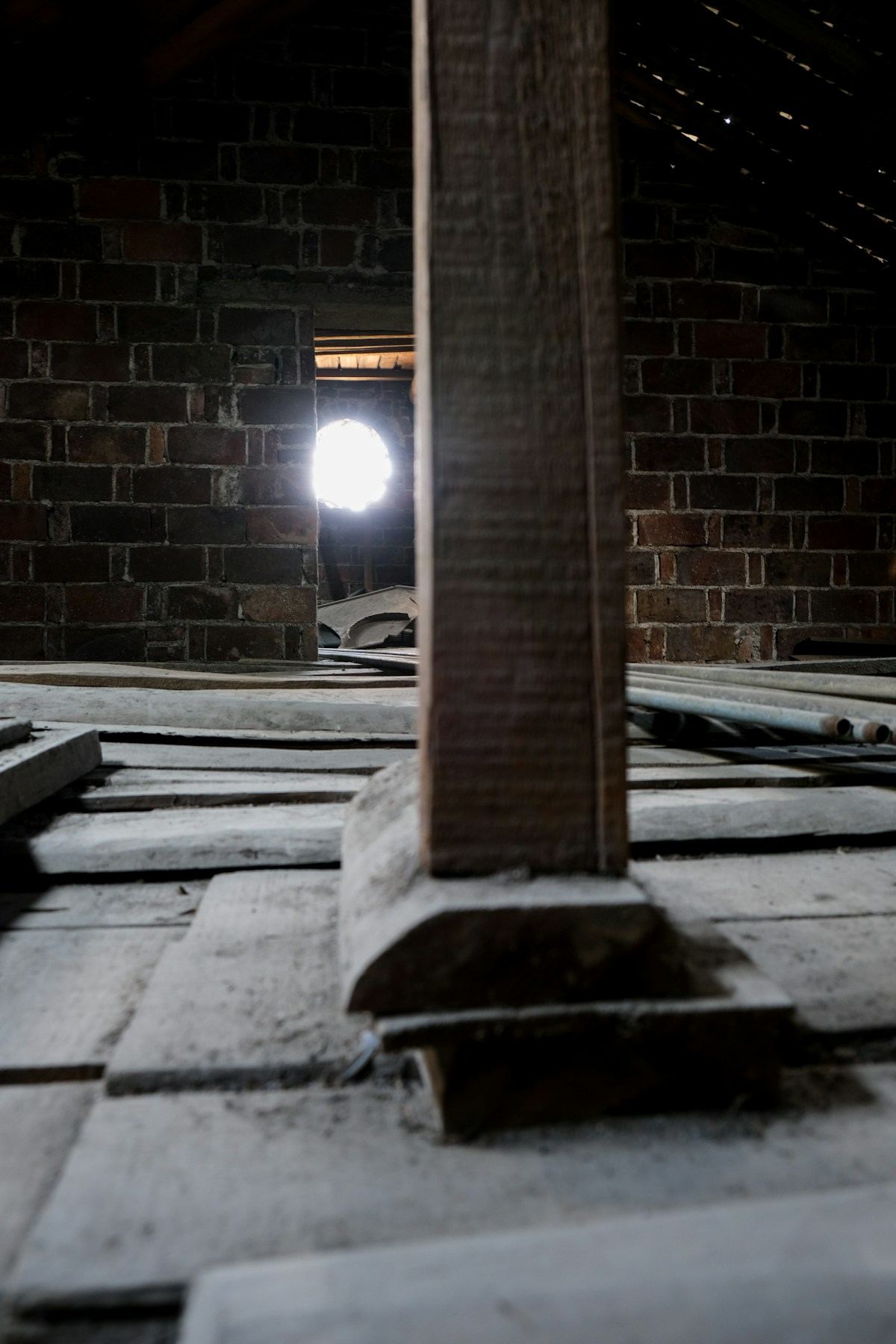
Attic spaces in pre-1950 Stockton and Lodi homes are where knob-and-tube wiring shows up most — visible along joists and rafters.
Where you will find K&T in San Joaquin County
K&T tracks closely with neighborhood age. In Stockton, you encounter it most often in homes near downtown, the Magnolia Historic District, and the older streets around Yosemite Lake. In Lodi, large parts of the pre-1950 housing stock around downtown and the older Eastside streets still have K&T somewhere, even if visible outlets have been modernized. Manteca's Old Town and a few Tracy pockets also turn up active K&T during inspections. You will not see K&T behind drywall without opening it up — look in unfinished attics, basements, and crawl spaces.
The real risks (and the risks that get overstated)
Honest assessment: intact, undisturbed K&T installed in a home that still has 1920s electrical loads is not particularly dangerous. The problem is that no such home exists in 2026. The actual risks in a modern home with K&T:
Insulation degradation. Rubber and cloth becomes brittle over decades, cracks, flakes off, exposes bare copper.
No equipment ground. K&T is a two-wire system with no ground conductor. Any three-prong outlet on a K&T circuit is ungrounded or bootlegged.
Overloading. A circuit originally sized for two lamps now feeds a window AC, a space heater, and a gaming PC. The wire was never designed for that current.
Buried K&T. The single biggest hazard. K&T was designed to dissipate heat into open air. When previous owners blow insulation on top of active K&T, the heat has nowhere to go. Most insurance carriers treat insulation-contact K&T as an automatic decline.
Bad modifications. Most homes with K&T have had decades of amateur splicing, junction box additions, and partial Romex extensions. The splices are where fires start, not the original installation.
The insurance reality in California
California homeowner insurance carriers have tightened significantly on K&T over the last several years. Many will not write a new policy on a home with any active K&T. Others will write the policy but require a letter from a licensed electrician confirming the K&T is de-energized or remediated within a set period. A handful of specialty carriers will cover it at substantially higher premiums. If you are buying a pre-1950 home in Stockton or Lodi, get the insurance quote before you remove the inspection contingency.
Your three remediation options
There are three reasonable paths:
Full rewire. The gold standard. An electrician runs new modern circuits and de-energizes the K&T in place. Pair with a panel upgrade if your main is also original. Only option that fully clears insurance concerns.
Partial replacement. Target the highest-risk sections: anything in contact with insulation, anything in a kitchen or bathroom, anything feeding a modern high-load appliance. Cheaper but not always acceptable to insurance carriers.
Document and de-energize. Keep K&T physically in place but disconnect it from the panel and rewire only the circuits actively in use. Acceptable for short-term ownership but does not increase home value the way a full rewire does.
The hidden problem: mixed wiring
The most common situation we encounter is not pure K&T or pure modern wiring. It is a home where a previous owner rewired the kitchen in 1978, added a bedroom circuit in 1995, replaced the panel in 2010, but left the original K&T feeding the upstairs lights. The visible parts look modernized. The hidden parts are still 1925. This is why a real electrical inspection matters more than a walkthrough. If you also have aluminum branch wiring, see our companion article on aluminum wiring risks.
Frequently Asked Questions
Is knob-and-tube wiring illegal in California?
No. Existing K&T is generally allowed to remain as long as it is intact, not modified improperly, and not buried in insulation. New K&T installation has not been permitted for decades. The legal question is usually less important than the insurance question.
Can I just add insulation around my K&T to save on heating?
No. California energy code and the NEC both prohibit thermal insulation in contact with active K&T. If you want to insulate your attic, the K&T has to be de-energized, removed, or fully replaced first. The most common code violation we find in older homes.
How much does a full K&T rewire cost in Stockton?
A typical 1,200–1,600 sq ft pre-war home in Stockton or Lodi generally runs in the mid five figures for a full rewire including a panel upgrade. The electrician we refer provides a written quote after walking the home.
Does Can Do It Electrical do the rewire work directly?
No. We are a residential electrician referral and job-coordination service. We connect Stockton-area homeowners with independent licensed electricians and help scope the job.
My home inspector said the K&T looks fine. Do I still need to worry?
Possibly. Home inspectors are generalists and typically only flag visibly damaged K&T. They often cannot tell whether buried K&T exists under blown-in insulation. A licensed electrician with thermal imaging can answer those questions.
Will my insurance company find out if I do not tell them?
Eventually, yes. Carriers increasingly require four-point inspections or wiring affidavits at renewal, and any claim involving electrical damage triggers an investigation. Failing to disclose known K&T can void coverage.
Written by the Can Do It Electrical team. Can Do It is a Stockton-based electrical referral service — we connect Central Valley homeowners and businesses with licensed, vetted local electricians and write about the electrical patterns we see in real Stockton-area jobs.
✅ Request received! We'll be in touch within a few hours. Thanks!
Can Do It Electrical is a referral and job coordination service. We are not a licensed electrical contractor. All electrical work is performed by independent licensed contractors. Contractor license numbers available upon request.