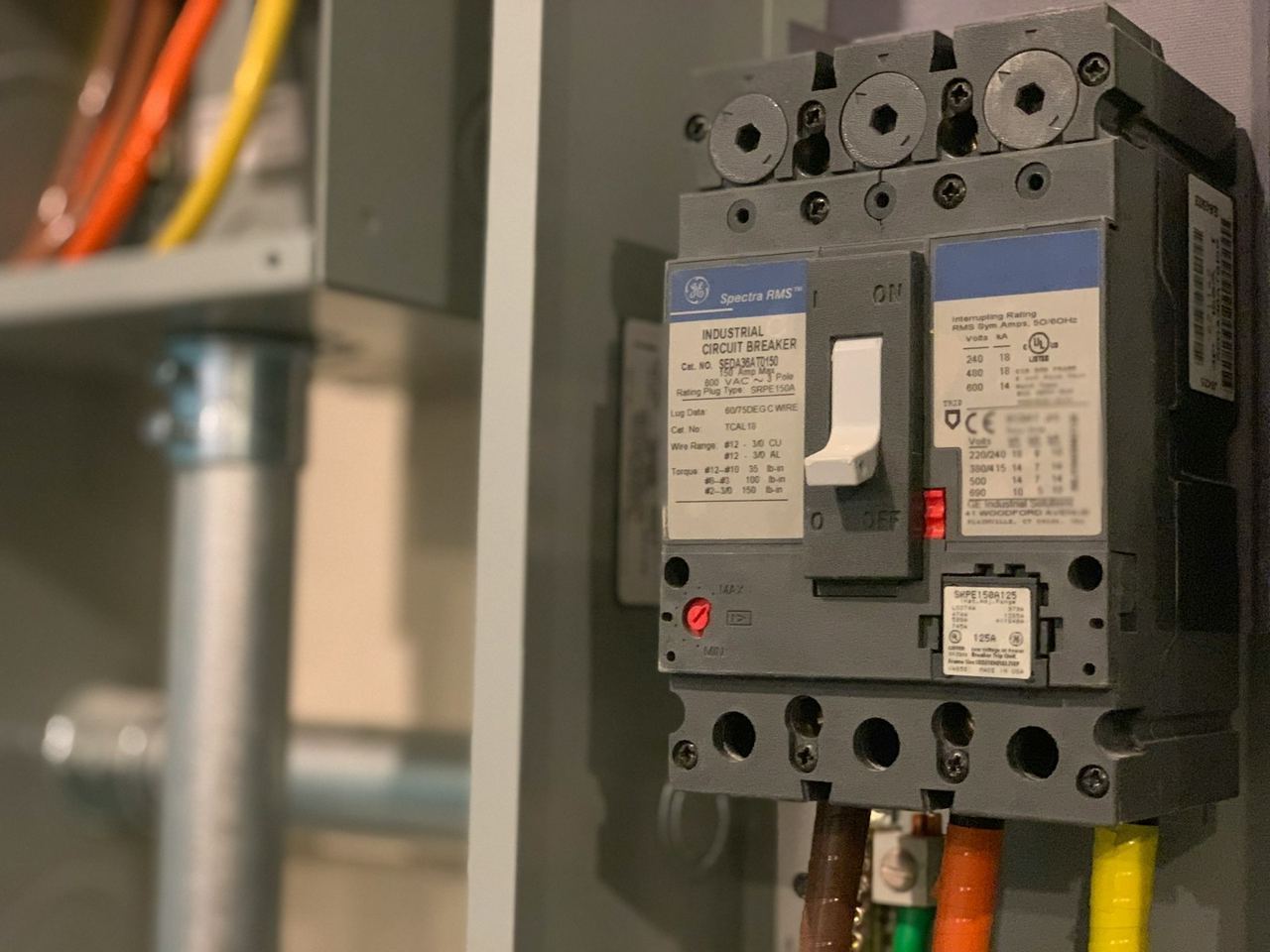
A GFCI stops shocks; an AFCI stops fires. GFCIs detect current escaping a circuit through a person or a wet surface and trip in about 1/40th of a second — fast enough to prevent electrocution. AFCIs detect the chaotic waveform of arcing (loose connections, damaged wires, pinched cords) and cut power before ignition. California code requires GFCI in wet locations (bathrooms, kitchens, garages, outdoors) and AFCI in nearly every living space, but most Central Valley homes built before the mid-2000s have neither. Here's how each works and where retrofitting matters.
GFCI stands for Ground Fault Circuit Interrupter. Its job is to detect current escaping the circuit and traveling to ground through something it should not — like a person standing on a wet bathroom floor touching a faulty hair dryer, or a kid sticking a fork into an outlet near the kitchen sink.
A GFCI constantly compares current going out on the hot wire with current coming back on the neutral. In a healthy circuit those match. If even 4–6 milliamps starts leaking somewhere else, the GFCI trips in roughly 1/40th of a second — fast enough to prevent a fatal shock.
California code requires GFCI in any location where water and electricity might meet: bathrooms, kitchen countertops, garages, outdoor receptacles, unfinished basements, laundry, near pools and spas, and crawl spaces. If your older Stockton home has a bathroom outlet without TEST and RESET buttons, it is not GFCI-protected and you are due for an upgrade through our outlet replacement coordination.
AFCI stands for Arc Fault Circuit Interrupter. Where a GFCI watches for current going somewhere it should not, an AFCI watches for a specific signature — the irregular, chaotic waveform produced by arcing.
Arcing happens when electricity jumps a gap it is not supposed to: a loose backstab connection behind an outlet, a nail driven through a wire during a remodel, a cord pinched under furniture, frayed insulation in an attic. These arcs throw sparks hot enough to ignite framing, insulation, and dust. The U.S. Fire Administration attributes tens of thousands of home fires every year to electrical arcing.
AFCI breakers use signal-processing chips to distinguish a dangerous arc from harmless ones (like the tiny spark a vacuum motor makes when it starts). When the breaker sees the dangerous pattern, it cuts power before the arc can ignite anything.
When AFCIs first appeared in the 2002 NEC, they were required only in bedrooms. Each code cycle since has expanded the requirement. Under the code California currently enforces, AFCI protection is required in nearly every living space.
Because so many circuits now require both — a kitchen counter receptacle needs GFCI for water and AFCI for fire — manufacturers make dual-function (DF) breakers that handle both in a single device. For new panels and most remodels, DF breakers have largely replaced separate AFCI and GFCI breakers. They cost more than a standard breaker but free up panel space and simplify wiring. If your panel is being replaced, ask whether DF breakers make sense for your protected circuits.
Both GFCI and AFCI devices have a built-in TEST button. Manufacturers and the NFPA recommend pressing it monthly.
For a GFCI outlet: plug in a small lamp, press TEST. The lamp should go off and RESET should pop out. Press RESET to restore. If the lamp does not go off, the GFCI has failed and needs replacement.
For an AFCI breaker: open the panel, press TEST on the breaker. It should snap OFF. Flip it back ON.
These devices wear out after 10–15 years. Surges, lightning, and Central Valley heat all shorten their lives. If a device will not reset, trips constantly, or fails its monthly test, replace it — but do not ignore nuisance tripping, because sometimes it is catching a real fault.
Homes built in Stockton before the early 2000s often have zero AFCI protection and only partial GFCI coverage. California does not generally require you to retrofit an existing home unless you are remodeling — but pulling permits for a kitchen or bath remodel triggers requirements on the affected circuits.
Many homeowners retrofit voluntarily, especially after a scare like a melted outlet or a smell of burning plastic. The common path is replacing standard breakers with AFCI or DF breakers at the panel, which protects everything downstream. Where panel-level retrofit is not practical (obsolete brands), an electrician can install GFCI/AFCI receptacles at the first outlet on each circuit. An electrical inspection is the right starting point if you are not sure what you have.
Describe your electrical job and where you're located. We'll match you with the right person and get back to you fast — usually same day.
No obligation. Takes 30 seconds.